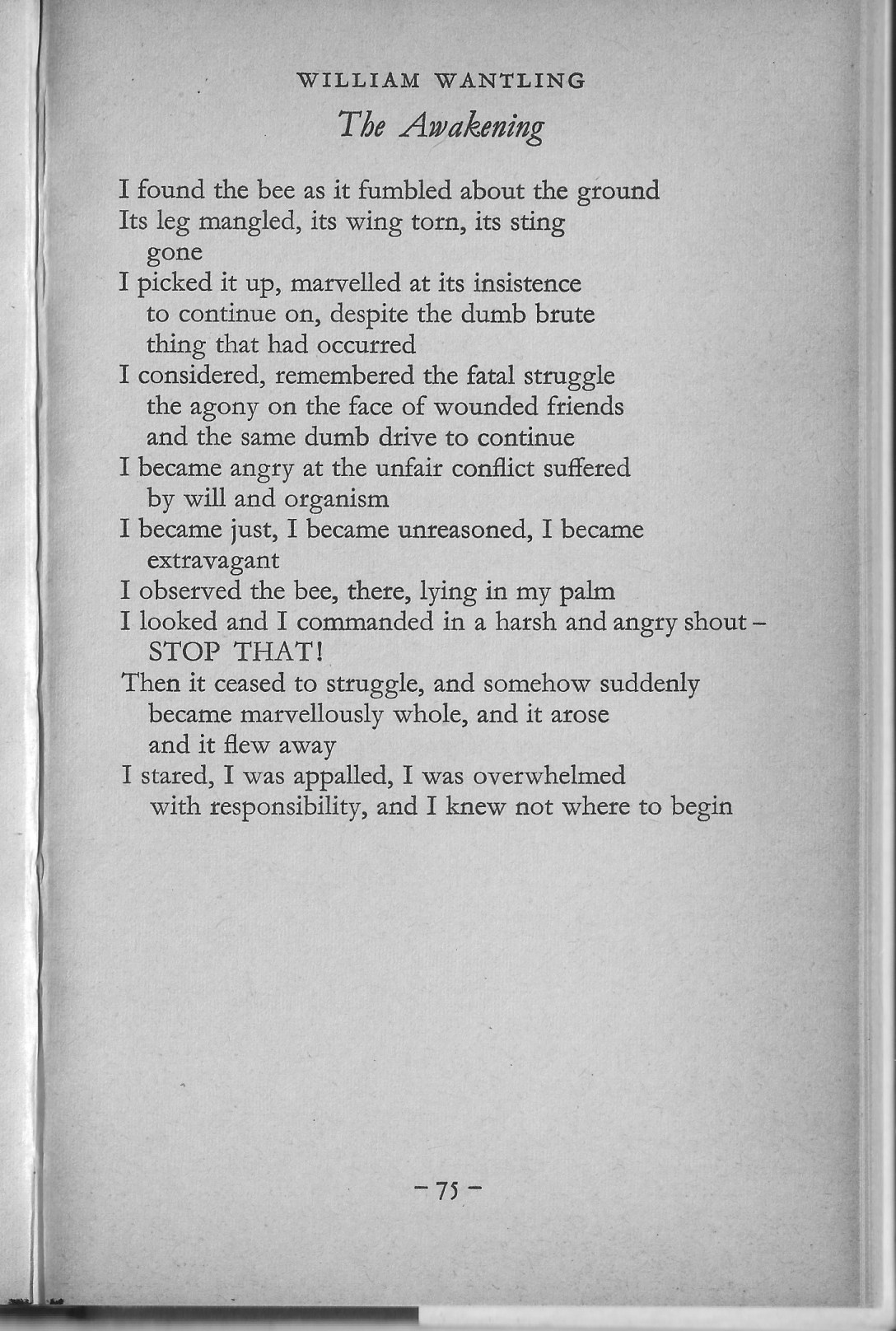
I came across this poem at a community event in Somers Town. I'd never heard of the poet or the poem before but it really struck me. The organizer of the event (Sylvi Temple) kindly emailed a photo of it to me.

The event was a unique combination of poetry and gardening held in the forecourt of a block of flats near the British Library. It was a celebration on the Islamic festival Ead and an ushering in of spring after a long winter. We took it in turns to read out segments of poems and songs by people as disparate as Joni Mitchell and Rumi. I also read two of my poems. Sylvi introduced William Wantling as a veteran of the Korean War. A poet little known even in his native United States. The poem slowly unfolded under blue sky and sun among an eclectic bunch of Somers Town residents.

The image of the wounded bee as it sat in the speaker’s hand; its “dumb drive” to survive was burned into my imagination. He talks about a “dumb brute thing that had occurred” paralyzing the bee. It reminded him of wounded comrades in Korea and their blind drive to fight on.

My friend Alice Woolf sometimes uses the analogy of a fly trapped in a web to describe her and my situations. She has struggled with the debilitating effects of severe ME and depression for many years. The stuckness I experience in my own illness is similar to hers. She talks about the fly struggling to break free then becoming exhausted, rallying, fighting again and then becoming exhausted again. I have experienced a mental block for time out of mind.

In the rough, unpretentious language of the poem it is as if the little creature’s suffering is drawn up into the consciousness of the man. He then reflects on it, becomes angry, “unreasoned...extravagant”. He harshly commands the bee to “STOP THAT!” When the bee ceases to struggle against its horrible fate, it becomes “marvellously whole” and flies away. The appalling, overwhelming “Awakening” referred to in the title.

It made me think that in the knowledge of one’s own “unfair conflict” of heart and mind, there could be a kind of awakening. From the speaker’s own inner anguish comes an unexpected and quiet grace. In the poem the man becomes a kind of god. Comprehending the bee’s torment as no one else does then blasting a lightning bolt of truth out of the sky. It’s a combination of compassion and power that leaves him humbled and astonished.
Published by Ben Preston
Ben Preston is a poet washed up in London’s Somers Town. He’s worked as a bartender, factory operative, diamond controller, dabbled in philosophy and dropped out of everything. He’s starting again. He’s using the skills he’s developed in creative writing to forge a new life and a new identity.
View all posts by Ben Preston

 Ben Preston